
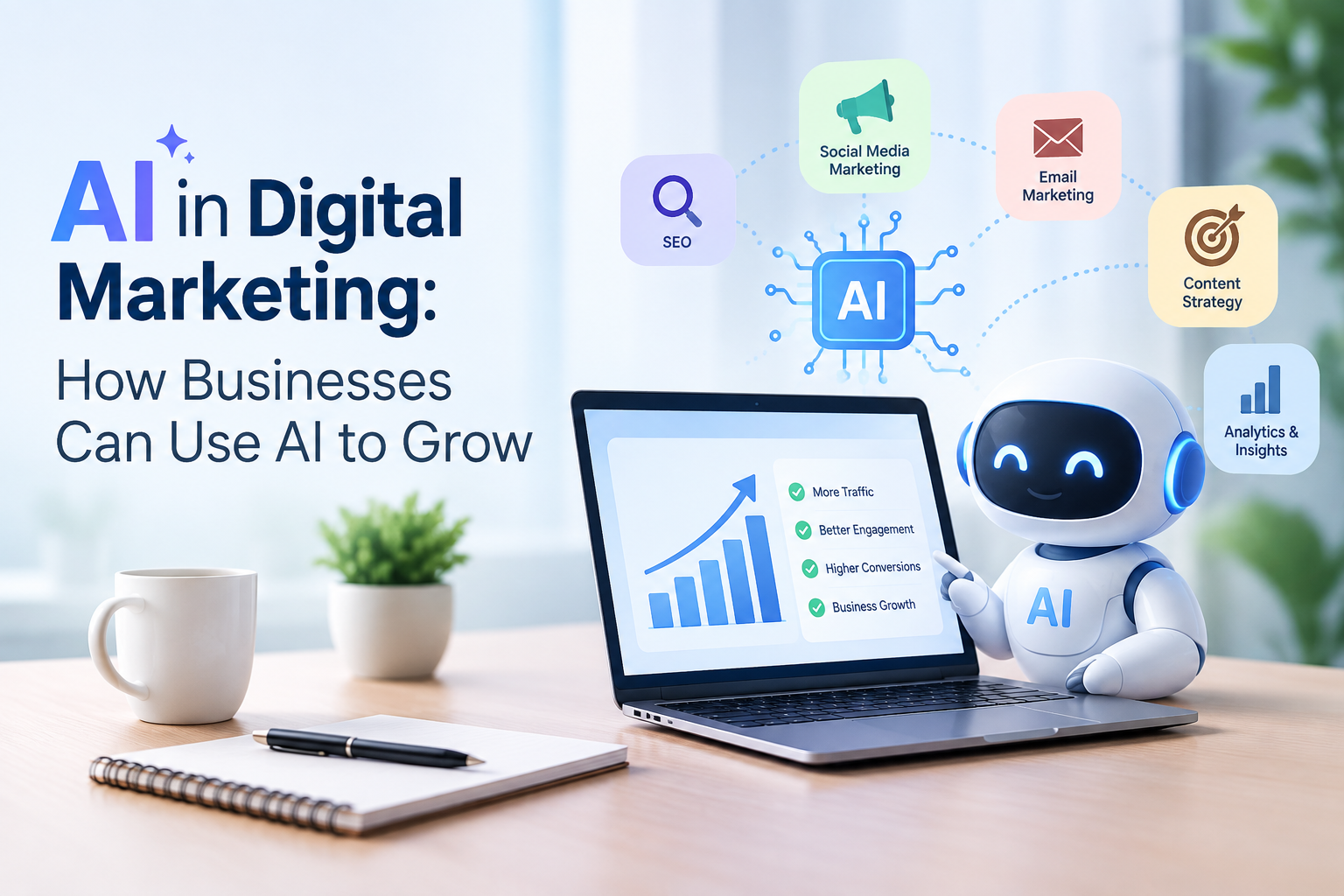
Digital marketing is changing quickly. Businesses now have access to more customer data, marketing channels, and automation tools than ever before.
Managing all of this manually can take time and effort.
This is where AI in Digital Marketing is becoming useful.
Artificial intelligence can help businesses understand customers, create content, analyse campaigns, automate repetitive tasks, and make faster marketing decisions. It does not replace the need for marketers. Instead, it helps teams work smarter and focus on strategy.
For small businesses, startups, and growing brands, AI can also make advanced marketing capabilities more accessible.
AI in digital marketing refers to the use of artificial intelligence technologies to plan, execute, analyse, and improve marketing activities.
AI systems can process large amounts of information in a short time. They can identify patterns in customer behaviour and use those patterns to support marketing decisions.
AI can be used across several areas, including:
The goal is simple. Businesses can use AI to make marketing more relevant, efficient, and data-driven.
Traditional marketing often involves repetitive work. Teams may spend hours analysing reports, writing basic content, sorting leads, or checking campaign performance.
AI marketing tools can reduce much of this manual workload.
They can analyse data quickly and highlight useful patterns. Marketers can then use these insights to make better decisions.
AI also helps businesses respond faster. A chatbot can answer common questions at any time. An automated system can follow up with a lead after a form submission. An AI tool can also suggest content ideas based on customer interests.
This does not mean every marketing task should be automated. Human input remains important for brand voice, creativity, positioning, and decision-making.
There are several ways artificial intelligence in marketing can improve everyday business operations.
Understanding customers is central to successful marketing.
AI can analyse information such as browsing behaviour, purchase history, engagement, and interactions. It can identify customer segments based on their interests and actions.
These insights can help marketers create more relevant campaigns.
A clothing brand, for example, may identify customers who regularly purchase activewear. It can then create campaigns specifically for that audience instead of sending the same message to everyone.
Customers respond better to relevant communication.
AI can help businesses personalise emails, product recommendations, website experiences, and advertisements.
An online store can recommend products based on previous purchases. A service business can send reminders based on customer activity. A content platform can suggest articles based on reading behaviour.
Personalisation can improve engagement and create a more relevant customer experience.
Content remains an important part of digital marketing. Yet creating blogs, social posts, product descriptions, emails, and ad variations can take considerable time.
AI-powered marketing tools can help generate initial ideas, outlines, headlines, captions, and drafts.
Marketers can then review and improve the content.
This approach works better than publishing AI-generated content without human editing. Brand guidelines, accuracy, originality, and audience expectations still need human attention.
Paid advertising generates large amounts of performance data.
AI can help analyse this information and identify patterns in clicks, conversions, audiences, and spending.
Marketing teams can use these insights to improve targeting and campaign performance.
AI can also help create multiple ad variations. Marketers can test different headlines, messages, and creative concepts to understand what works best.
Lead follow-up is another area where AI can make a difference.
A business may receive leads through its website, social media, search campaigns, or landing pages. Managing every lead manually can become difficult as the business grows.
AI can help categorise leads and identify potential high-value prospects.
Automated workflows can also send follow-ups, reminders, and relevant information.
This can help reduce missed opportunities.
The benefits of AI in digital marketing extend beyond automation. Businesses can use AI to improve both efficiency and decision-making.
Saves Time
AI can handle repetitive marketing tasks quickly. Teams can spend more time on planning, creative work, and customer strategy.
Supports Data-Driven Decisions
AI can analyse large datasets and identify patterns that may be difficult to notice manually. This gives marketers more information when making campaign decisions.
Improves Personalisation
Customer data can be used to create more relevant experiences. This can improve engagement across different marketing channels.
Helps Scale Marketing
A small marketing team can manage more campaigns with the right automation. AI can support content production, reporting, customer communication, and lead management as business needs increase.
Improves Customer Experience
Chatbots, automated responses, personalised recommendations, and timely communication can make interactions faster and more convenient.
Businesses do not need to use every AI tool available. The right technology depends on the business model, goals, audience, and marketing channels.
Common categories of AI tools for digital marketing include:
The key is to choose tools that solve actual business problems. Adding technology without a clear purpose can create more complexity instead of improving marketing.
Businesses can start small.
There is no need to completely change the marketing process overnight.
A practical approach is to identify repetitive tasks first. Content research, lead sorting, reporting, email follow-ups, and customer queries are good areas to explore.
The next step is to define a clear objective.
For example, a business may want to:
Once the objective is clear, the business can select suitable AI solutions.
It is also important to measure results. Track metrics such as conversion rate, cost per lead, customer engagement, response time, and revenue. This helps determine whether the technology is actually creating value.
Search marketing is another area being influenced by AI.
Businesses can use AI to understand search intent, identify content opportunities, organise topics, and improve existing content.
AI can also help marketers analyse competitors and discover questions customers are asking.
However, SEO still requires quality and originality. Search engines reward useful content that meets user needs. AI should support the content process, not become a shortcut for producing large volumes of generic pages.
A strong SEO strategy combines AI-assisted research with expert knowledge, human editing, and a clear understanding of the target audience.
AI offers significant opportunities, but it also has limitations.
AI systems can produce incorrect information. They may also misunderstand context or generate content that sounds repetitive.
Data privacy is another important consideration. Businesses should understand how customer information is collected, stored, and processed before using an AI platform.
Human oversight is essential. Marketing decisions can affect brand reputation, customer trust, and business performance.
The best approach is not to let AI make every decision. It is to use AI where it adds value and keep people involved where judgement matters.
AI digital marketing will continue to evolve as businesses collect more data and adopt smarter technologies.
Marketing may become increasingly personalised. Customer interactions may become more automated. Predictive analytics may help businesses identify potential customer needs earlier.
AI may also bring different marketing functions closer together. Content, advertising, CRM , analytics, and customer service can work through connected systems instead of separate processes.
Businesses that learn how to use these technologies responsibly can gain an operational advantage.
The focus, however, should remain on customers. Technology alone does not create a successful marketing strategy. Businesses still need a strong brand, useful products, clear communication, and a good understanding of their audience.
Adopting AI can feel complicated when a business has multiple marketing channels and processes to manage.
Luhaif Digitech helps businesses explore digital solutions that support growth, automation, and better marketing operations. Its approach focuses on using technology to address practical business requirements instead of adding tools without purpose.
Businesses can assess areas such as lead management, customer engagement, automation, digital marketing, and data-driven decision-making. The right strategy can then be built around specific goals.
AI does not have to be introduced everywhere at once. A focused implementation can often deliver better results.
AI is becoming an important part of modern marketing. It can help businesses analyse data, personalise customer experiences, automate repetitive tasks, improve campaigns, and manage leads more efficiently.
The real value lies in using AI strategically.
Businesses should start with clear objectives, choose relevant tools, monitor results, and keep human expertise at the centre of marketing decisions.
Looking to make AI a practical part of your digital marketing strategy? Connect with Luhaif Digitech to explore technology solutions designed around your business goals.


17153 STE 1 Bear Valley RdHesperia, CA 92345, USA

Block-d, Balaji Estate, Guru Ravidas Marg, Kalkaji, New Delhi-110019

123 Arabian Drive, Suite 306, Fort McMurray, Alberta, Canada T9H 5N9

201, Al Reyami building, Umm Hurair street, Dubai
Copyright © 2023 - 2024 Luhaif Digitech. All rights reserved.


